 By Graham Fisher
Updated November 2026
Yes, you can put rubber gym flooring over carpet in many home gyms, but the answer depends on the carpet’s pile height, how the rubber will be held in place, and how heavy your equipment is. The short version: thin, dense rubber tiles and mats usually sit well on low-pile carpet for light to moderate training, while thicker rubber and heavy plate loading call for a firmer base. This guide walks through six well-known options and the criteria we used to compare them: thickness, interlock or roll format, edge design, suitability for carpet, and how owners generally describe the results.
Our top picks at a glance
- 1
 TOP CHOICEBest overallHeavy Duty Gym Mat Flooring, Rubber Surface and High Density EVA Foam, 24" x 24"View on Amazon
- 2
 TOP CHOICEBest for dumbbell and light cardio zonesSUPERJARE High Density Gym Mat with Upgraded Rubber Top, 12 Pcs, 48 Sq FtView on Amazon
- 3
 TOP CHOICEBest for barbell and plate workExtra Thick 1/4" Rubber Gym Flooring for Weights, 9' x 6' Horse Stall MatView on Amazon
- 4
 Best for a clean, low-profile lookNon-Slip Interlocking Workout Mat, 24 x 24in, 0.56" Rubber TopView on Amazon
- 5
 Best for heavy commercial-style useAmerican Floor Mats Sport 8mm Heavy Duty Rubber Flooring, 23" x 23" Interlocking TileView on Amazon
- 6
 Best budget pick for large roomsTraxxon by FlooringInc Rubber Gym Flooring Roll, 1/4" Thick, 4' x 10'View on Amazon
Our Top Picks
| Product | Best for | Key feature |
|---|---|---|
| Heavy Duty Gym Mat Flooring 24″ x 24″ | Overall use on carpet | Interlocking tiles in 0.6″ or 0.8″ thickness |
| SUPERJARE 12-Piece Interlocking Gym Mat | Dumbbells and light cardio | Rubber top over high-density EVA foam, 48 sq ft |
| Extra Thick 1/4″ Rubber Gym Flooring 9′ x 6′ | Barbells and plate loading | 1/4″ solid rubber in a single large mat |
| Non-Slip Interlocking Workout Mat 24″ x 24″ | Low-profile setups | 0.56″ rubber top, 96 sq ft coverage |
| American Floor Mats Sport 8mm Interlocking Tile | Heavy, repeated use | Solid 8mm rubber tiles with expansion pack |
| Traxxon Rubber Gym Flooring Roll 4′ x 10′ | Large rooms and budget builds | Recycled rubber roll, 1/4″ thick, 40 sq ft |
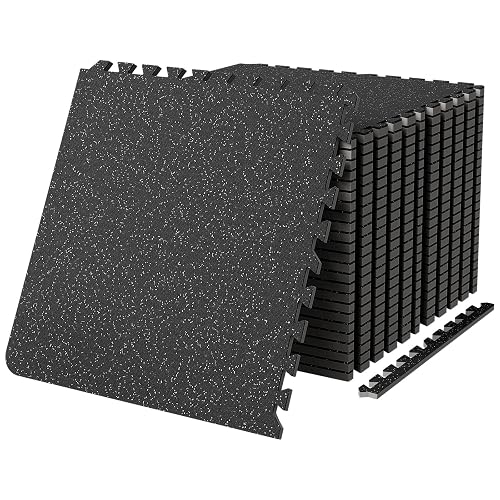
Heavy Duty Gym Mat Flooring, Rubber Surface and High Density EVA Foam, 24″ x 24″
Heavy Duty Gym Mat Flooring, Rubber Surface & High Density EVA Foam, Gym Flooring for Home Gym, Workout Mat, Garage Floor Mat 0.6"/0.8" Thick Interlocking Rubber Top Gym Floor Tiles, 24" x 24"
Best for: Overall use on carpet in a mixed home gym
This is a good fit for someone who wants a single, versatile tile system that can handle dumbbells, kettlebells, bodyweight work and light lifting over a carpeted floor. The rubber surface and foam core give a balance of cushioning and stability.
Key specs
- Interlocking tiles, 24″ x 24″
- Listed thickness options: 0.6″ and 0.8″
- Rubber top surface over high-density EVA foam base
Pros
- Interlocking edges keep seams tight across carpet
- Thickness options let you match the cushioning you want
- Easy to expand or reconfigure as the space changes
Cons
- Foam core is less rigid than solid rubber for very heavy plates
- Carpet pile can telegraph through thinner tiles under point loads
Bottom line: Pick this if you want one flexible tile system for a carpeted room with mixed training.
SUPERJARE High Density Gym Mat with Upgraded Rubber Top, 12 Pcs, 48 Sq Ft
High Density Gym mat with Upgraded Rubber Top, 12 Pcs Interlocking EVA Foam Exercise Equipment mat, Workout Mat, Black/Grey SUPERJARE 0.56'' Thick 48 Sq Ft Rubber Top Gym Flooring for Home Gym
Best for: Dumbbells and light cardio zones
Suited to a home gym where most work is dumbbells, machines and light cardio, and where you want enough tiles to cover a meaningful area without buying a roll.
Key specs
- 12 interlocking pieces, 48 sq ft total
- Listed thickness: 0.56″
- Rubber top over EVA foam
Pros
- Good coverage per set for the footprint
- Rubber top helps grip under shoes and equipment feet
- Simple layout that fits a standard carpeted bedroom
Cons
- Not as firm as solid rubber under heavy barbell drops
- Seams can show slight edge lift on plush carpet if not pressed flat
Bottom line: A practical choice for a carpeted room focused on dumbbells and cardio rather than heavy loading.
Extra Thick 1/4″ Rubber Gym Flooring for Weights, 9′ x 6′ Horse Stall Mat
1/4" Extra Thick Rubber Gym Flooring for Weights, Training, Plates, Stretching, Cardio or Fitness Equipment, Horse Stall Mat Large Workout Mat for Home Garage Gym 9’x6’, Non Slip Exercise Mat
Best for: Barbells and plate loading
For lifters who load plates and want a firmer, more continuous surface. A single large mat avoids seams entirely, which helps when rolling a loaded bar.
Key specs
- 1/4″ thick rubber
- Dimensions: 9′ x 6′
- Non-slip rubber surface
Pros
- Seamless surface suits barbell and cart movement
- Thicker than most interlocking tiles
- Large footprint covers a full lifting zone
Cons
- Heavy and harder to move or reposition on carpet
- Single mat does not adapt to irregular room shapes
Bottom line: Best for a dedicated lifting corner where the mat stays put once laid.
Non-Slip Interlocking Workout Mat, 24 x 24in, 0.56″ Rubber Top
Non-Slip Interlocking Workout Mat, 24 x 24in Large Gym Floor Mat, Protect Floors from Equipment, 96 Sq Ft, Black/Blue 0.56" Rubber Top Gym Flooring, Heavy Duty Gym Mats for Home Gym
Best for: Low-profile setups
A good match for a carpeted room where you want a thinner footprint so doors and equipment still clear the floor. The interlocking design keeps coverage consistent.
Key specs
- Tiles: 24″ x 24″
- Thickness: 0.56″
- Coverage: 96 sq ft
Pros
- Lower profile than many thicker tiles
- Large total coverage for the price tier
- Non-slip top surface
Cons
- Thinner build may feel firmer on carpet than on hard subfloor
- Less cushioning for high-impact work
Bottom line: Choose this for a clean, low-height setup over carpet with moderate loads.
American Floor Mats Sport 8mm Heavy Duty Rubber Flooring, 23″ x 23″ Interlocking Tile
American Floor Mats Sport 8mm Heavy Duty Rubber Flooring – Interlocking Rubber Tile (23" x 23") Solid Black – 6 Center Tiles Expansion Pack
Best for: Heavy, repeated use
For a serious home gym where the floor takes repeated impact and the owner wants solid rubber rather than foam-backed tiles.
Key specs
- Thickness: 8mm
- Tile size: 23″ x 23″
- Expansion pack includes 6 center tiles
Pros
- Solid rubber construction for durability
- Expansion pack makes it easy to grow the footprint
- Interlocking edges stabilize the surface
Cons
- Heavier and firmer, so it may not suit very soft carpet well
- Smaller tiles mean more seams to manage
Bottom line: Pick this for a durable, firm surface over carpet if you train hard and want a solid base.
Traxxon by FlooringInc Rubber Gym Flooring Roll, 1/4″ Thick, 4′ x 10′
Traxxon by FlooringInc Rubber Gym Flooring Roll, Heavy Duty Recycled Rubber Floor Mats for Home Gym, Garage Gym Floor Mat, Horse Stall Mat (1/4" Thick | Black | 4'x10' | 40 Sq Ft)
Best for: Large rooms and budget builds
A roll format suits someone covering a larger rectangular area who wants fewer seams and is comfortable cutting the rubber to fit.
Key specs
- Thickness: 1/4″
- Dimensions: 4′ x 10′ (40 sq ft)
- Recycled rubber construction
Pros
- Fewer seams across a large carpeted area
- Recycled rubber is a common choice for budget-minded builds
- Thick enough for moderate weight work
Cons
- Roll can curl and needs time to flatten on carpet
- Cutting and fitting takes more planning than interlocking tiles
Bottom line: A sensible pick for a larger room where you can measure carefully and lay it flat before loading.
Buying Guide
Carpet pile height
Low-pile or commercial carpet supports rubber tiles far better than deep, plush pile. Plush carpet compresses under weight, which can make tiles rock and seams open. As a rule of thumb, if you can press a coin into the carpet and it sinks more than a few millimeters, expect instability.
Good picks for this: American Floor Mats Sport 8mm Interlocking Tile, Non-Slip Interlocking Workout Mat
Thickness and cushioning
Thicker tiles absorb more impact and protect the subfloor, but they also raise the training surface. Thinner tiles keep the height low but transmit more vibration. Match thickness to the heaviest thing you plan to drop.
Good picks for this: Heavy Duty Gym Mat Flooring, Extra Thick 1/4″ Rubber Gym Flooring
Interlocking tiles versus rolls
Interlocking tiles are easier to install and reconfigure, and they handle irregular rooms well. Rolls offer fewer seams and a continuous surface, but they need careful measuring, flattening and cutting.
Good picks for this: SUPERJARE 12-Piece Interlocking Gym Mat, Traxxon Rubber Gym Flooring Roll
Size and fit for your room
Measure the full area, then add clearance for racks and benches. Interlocking tiles let you build to exact dimensions. For a 10′ x 12′ room, tile coverage can be cut to fit around door swings and outlets.
Good picks for this: Non-Slip Interlocking Workout Mat, SUPERJARE 12-Piece Interlocking Gym Mat
Load type and use case
Dumbbells, kettlebells and bodyweight work are gentle on flooring. Barbell drops, plate loading and sled pushes demand firmer, denser rubber. Be honest about your heaviest lift.
Good picks for this: Extra Thick 1/4″ Rubber Gym Flooring, American Floor Mats Sport 8mm Interlocking Tile
Durability and edge design
Solid rubber generally outlasts foam-backed tiles under heavy use. Check whether edges are beveled or interlock securely, since loose edges catch equipment wheels and shift over carpet.
Good picks for this: Heavy Duty Gym Mat Flooring, American Floor Mats Sport 8mm Interlocking Tile
Care and maintenance on carpet
Rubber can trap moisture against carpet, so vacuum regularly and lift tiles occasionally to check for dampness or odor. Avoid heavy solvent cleaners that can degrade rubber. Consult a flooring professional if you notice mold or carpet damage.
Good picks for this: Non-Slip Interlocking Workout Mat, Traxxon Rubber Gym Flooring Roll
FAQ
Can you put rubber gym flooring over carpet without removing the carpet?
Yes, in many cases. Low-pile, firmly anchored carpet is commonly used as a base for interlocking tiles and rolls. Plush or loose carpet is less suitable because it compresses and can let the rubber shift.
Will rubber flooring damage carpet?
Prolonged contact can cause matting, staining or mildew, especially if moisture is trapped. Lifting the mats periodically and keeping the room ventilated reduces these risks.
Do I need an underlayment?
Often no, because the rubber itself provides the cushioning layer. Adding padding under rubber over carpet usually makes the surface less stable, so most builds skip it.
Are interlocking tiles or rolls better over carpet?
Interlocking tiles are generally easier to install and adjust. Rolls give fewer seams but are harder to flatten and cut on carpet. Your room shape and budget will help decide.
How thick should the rubber be for dumbbells?
For dumbbells and light work, 0.5″ to 0.8″ is a common range. For heavy barbell work, owners often choose 1/4″ solid rubber or thicker tiles, but check the manufacturer’s load recommendations.
Is rubber over carpet safe for heavy weights?
Plate loading on carpet can compress the pad and create an unstable surface. If you lift heavy, consider a firmer base and consult a qualified professional for advice on floor loading and structural limits.
Can I move the rubber flooring later?
Interlocking tiles can be lifted and relaid easily. Rolls are harder to move, especially when heavy, so plan your layout before you install.
Conclusion
You can put rubber gym flooring over carpet in many home gyms, provided the carpet is low-pile and firmly attached and the rubber suits your loads. For an all-round carpeted setup, the Heavy Duty Gym Mat Flooring tiles are a practical starting point. Choose the SUPERJARE set for dumbbell and cardio zones, the 1/4″ Extra Thick mat for barbell work, the Non-Slip Interlocking Mat for a low profile, the American Floor Mats Sport tiles for heavy use, and the Traxxon roll for larger rooms where fewer seams matter. Check your carpet pile and lift tiles now and then to keep the floor dry and stable.
Sources
- Consumer safety guidance on home fitness equipment and floor-related injuries (cpsc.gov)
- Workplace floor safety and slip-resistance principles that apply to exercise areas (osha.gov)
- Exercise facility design and safe training space recommendations (acefitness.org)
Before you buy: helpful guides
- Rubber Flooring Rolls for Home Gym: How to Choose and Install (Step-by-Step)
- Gym Flooring on Top of Carpet: How to Do It Safely (Step-by-Step)
- 8mm Rubber Gym Flooring: How to Choose, Measure and Install It
- How to Clean Rubber Gym Flooring: A Step-by-Step Guide for Home Gyms
- How to Install Rubber Gym Flooring: A Step-by-Step Guide for Home Gyms
Related reading
- Top 8 Rubber Gym Flooring Over Carpet Options for Home Gyms in 2026
- Can You Put Gym Flooring Over Carpet? 7 Best Picks Compared
- Gym Flooring Over Carpet: 5 Best Picks for Home Gyms (2026)
About Graham Fisher
Graham Fisher is part of our editorial team and reviews and edits our budget home gym equipment guides, checking product details against manufacturer specifications and owner feedback.