By Graham Fisher
Updated November 2026
Flooring for gym equipment has one job that matters more than anything else: it protects your subfloor from heavy weights, keeps racks and benches from shifting, and absorbs enough sound that your downstairs neighbors don’t hear every dropped dumbbell. This guide compares six interlocking mats that home gym owners commonly consider. Our selection criteria were thickness and density, surface grip, tile size and coverage, ease of installation, and how well each product fits a typical garage or spare-room gym. We did not test these mats ourselves. The picks reflect manufacturer specifications and the feedback patterns owners often describe.
Our top picks at a glance
- 1
 TOP CHOICEBest overallSUPERJARE High Density Gym Mat with Upgraded Rubber Top, 12 PcsView on Amazon
- 2
 TOP CHOICEBest for heavy racksInterlocking Gym Flooring for Home Gym, Heavy Duty 24x24in TilesView on Amazon
- 3
 TOP CHOICEBest budget pickSUPERJARE High Density EVA Foam Mats with Rubber Top, 24 PcsView on Amazon
- 4
 Best for lifting platformsSUPERJARE Rubber Top Floor Tiles with High Density EVA Foam, 18 PcsView on Amazon
- 5
 Best for grip-focused workoutsUltra-grip Interlocking Gym Floor Mat, 24x24in Rubber Gym FlooringView on Amazon
- 6
 Best for a clean, simple layoutNon-Slip Interlocking Workout Mat, 24x24in Large Gym Floor Mat, 48 Sq FtView on Amazon
Our Top Picks
| Product | Best for | Key feature |
|---|---|---|
| SUPERJARE High Density Gym Mat, 12 Pcs, 48 Sq Ft | Most home gyms | 0.56″ thick EVA base with rubber top |
| Interlocking Gym Flooring, 12 Tiles, 48 Sq Ft | Heavy racks and benches | Non-slip high density EVA foam |
| SUPERJARE EVA Foam Mats, 24 Pcs, 96 Sq Ft | Larger spaces on a tighter budget | Greater coverage at 0.4″ thickness |
| SUPERJARE Rubber Top Floor Tiles, 18 Pcs, 72 Sq Ft | Olympic lifting and drops | 0.79″ extra-thick cushioning |
| Ultra-grip Interlocking Gym Floor Mat, 24x24in | Grip-heavy training | Textured rubber surface |
| Non-Slip Interlocking Workout Mat, 48 Sq Ft | Simple, uniform coverage | 0.56″ rubber top with interlocking edges |
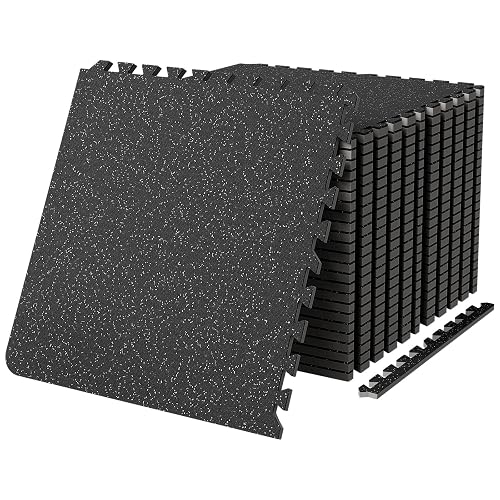
SUPERJARE High Density Gym Mat with Upgraded Rubber Top, 12 Pcs
High Density Gym mat with Upgraded Rubber Top, 12 Pcs Interlocking EVA Foam Exercise Equipment mat, Workout Mat, Black/Grey SUPERJARE 0.56'' Thick 48 Sq Ft Rubber Top Gym Flooring for Home Gym
Best for: Most home gyms that need a balanced all-around floor.
This is a solid default for someone setting up a garage or basement gym with a mix of free weights, a rack and cardio equipment. Its 0.56-inch profile is thick enough to protect most subfloors without making the surface unstable.
Key specs:
- Thickness: 0.56 inches
- Coverage: 48 sq ft across 12 pieces
- Construction: high density EVA foam base with rubber top
- Interlocking tiles for a floating installation
Pros:
- Thickness suits most racks and benches
- Rubber top offers reliable grip under shoes
- Easy to cut with a utility knife for edges
Cons:
- Rubber top can show scuffs over time under heavy sliding
- Strong solvent odors are sometimes reported in the first days after unboxing
Bottom line: A strong first choice for someone who wants one floor that handles everything reasonably well.
Interlocking Gym Flooring for Home Gym, Heavy Duty 24x24in Tiles
Interlocking Gym Flooring for Home Gym, Heavy Duty Gym Mat, Non-Slip High Density EVA Foam, 24x24in Tiles, Protect Floors 0.56" Thick Rubber Top Exercise Equipment Mats, 12 Tiles 48 Sq Ft
Best for: Heavy racks, benches and loaded barbell work.
Owners who set down heavy equipment often look for tiles with a dense base that resists compression. This product’s 24-by-24-inch tile size makes it easy to build a clean footprint under a rack.
Key specs:
- Tile size: 24 x 24 inches
- Thickness: 0.56 inches
- Coverage: 48 sq ft across 12 tiles
- Material: high density EVA foam with rubber top
Pros:
- Large tiles mean fewer seams under equipment
- Non-slip top helps equipment stay put
- Heavy-duty construction suits rack loads
Cons:
- Large tiles are harder to move once installed
- Edges may need trimming to fit irregular rooms
Bottom line: Best for lifters who load racks and want a stable, seam-light base.
SUPERJARE High Density EVA Foam Mats with Rubber Top, 24 Pcs
High Density EVA Foam Mats with Rubber Top, Interlocking Gym Flooring for Home Gym, Protective Workout Mat, Black/Grey SUPERJARE 0.4'' Thick 24 Pcs 96 Sq Ft Rubber Top Exercise Equipment Mats
Best for: Covering a larger area on a tighter budget.
If you need to cover a two-car garage bay or a full basement room, this option gives you 96 square feet at a thinner 0.4-inch profile. It works well for lighter training, bodyweight work and cardio machines.
Key specs:
- Thickness: 0.4 inches
- Coverage: 96 sq ft across 24 pieces
- Construction: EVA foam base with rubber top
- Interlocking design
Pros:
- Large total coverage for bigger rooms
- Good value for wide floor areas
- Lightweight enough for one person to lay
Cons:
- Thinner profile offers less protection under heavy drops
- Not ideal for Olympic lifting platforms
Bottom line: A practical pick for larger rooms where the heaviest work happens on a separate platform.
SUPERJARE Rubber Top Floor Tiles with High Density EVA Foam, 18 Pcs
Rubber Top Floor Tiles with High Density EVA Foam, Interlocking Gym Flooring for Home Gym, Workout Mat, Black/Grey SUPERJARE 0.79'' Extra-Thick 18 Pcs 72 Sq Ft Exercise Equipment Mats
Best for: Lifting platforms and areas where weights get dropped.
The extra-thick profile here is aimed at people who drop weights from overhead or stand on the floor during Olympic lifts. The extra cushioning helps protect the subfloor from impact.
Key specs:
- Thickness: 0.79 inches
- Coverage: 72 sq ft across 18 pieces
- Construction: high density EVA foam with rubber top
Pros:
- Extra thickness absorbs more impact
- Rubber top resists sliding under shoes
- Good for a dedicated lifting zone
Cons:
- Thicker tiles can feel less stable under heavy machines
- Costs more coverage per square foot than the thinner options
Bottom line: Choose this if your main concern is impact protection in a lifting zone.
Ultra-grip Interlocking Gym Floor Mat, 24x24in Rubber Gym Flooring
Ultra-grip Interlocking Gym Floor Mat, 24 X 24in Rubber Gym Flooring for Home Gym, Protect Floors from Equipment 0.56" Thick Rubber Top Gym Mats, Heavy Duty Gym Mats for Home Gym
Best for: Workouts where footing and grip matter most.
Owners doing sled pushes, sprints or footwork-heavy circuits often prioritize surface texture. This mat’s grip-focused top is designed for that kind of movement.
Key specs:
- Tile size: 24 x 24 inches
- Thickness: 0.56 inches
- Surface: textured rubber for grip
Pros:
- Strong surface grip for dynamic movement
- Interlocking tiles simplify installation
- Heavy-duty design for frequent use
Cons:
- Textured surface can be harder to clean than smooth tops
- Some owners find the texture rough on bare feet
Bottom line: A good fit for athletic training that involves a lot of footwork.
Non-Slip Interlocking Workout Mat, 24x24in Large Gym Floor Mat, 48 Sq Ft
Non-Slip Interlocking Workout Mat, 24 x 24in Large Gym Floor Mat, Protect Floors from Equipment, 48 Sq Ft, Black/Grey 0.56" Rubber Top Gym Flooring, Heavy Duty Gym Mats for Home Gym
Best for: A clean, uniform floor with minimal setup decisions.
This option suits someone who wants a simple, consistent surface without choosing between multiple thicknesses or textures. It covers a standard 48-square-foot area with 0.56-inch rubber-top tiles.
Key specs:
- Tile size: 24 x 24 inches
- Thickness: 0.56 inches
- Coverage: 48 sq ft
- Top: non-slip rubber
Pros:
- Uniform tiles simplify planning
- Non-slip top suits general training
- Covers a useful footprint for a single rack setup
Cons:
- Not the thickest option for heavy drops
- Edge pieces may need cutting to finish a room
Bottom line: A straightforward choice for a basic home gym with moderate weights.
Buying Guide
Thickness and impact protection
Thickness is the first number most buyers check, and for good reason. Mats in the 0.4-inch range are generally suited to light and moderate training. Around 0.56 inches is a common middle ground for racks and benches. Thicker mats near 0.79 inches are typically chosen for dropped weights and lifting zones. Remember that thicker is not always more stable, especially under heavy machines.
Good picks for this: SUPERJARE 0.56″ High Density Gym Mat and SUPERJARE 0.79″ Extra-Thick Floor Tiles.
Density and base material
High density EVA foam is the base material in most interlocking gym mats. Density affects how much the mat compresses under load. A mat that compresses too much can wobble under a rack, while a very firm one transmits more impact. Look for listings that specify high density rather than generic foam.
Good picks for this: Interlocking Gym Flooring 24x24in Tiles and SUPERJARE EVA Foam Mats, 24 Pcs.
Surface grip and texture
A rubber top helps shoes and equipment stay in place. Textured surfaces grip more aggressively, which helps with footwork and sled work but can be harder to wipe clean. Smoother rubber tops are easier to maintain. Choose based on what you do most, not on what looks best in photos.
Good picks for this: Ultra-grip Interlocking Gym Floor Mat and Non-Slip Interlocking Workout Mat.
Tile size and room fit
Measure your room before buying. Tiles in the 24-by-24-inch format are easy to lay and cut, and they produce fewer seams under equipment. Calculate square footage by multiplying length by width, then add 10 percent for trimming and waste. Interlocking edges make it simpler to build a floating floor that can be adjusted later.
Good picks for this: Non-Slip Interlocking Workout Mat and Interlocking Gym Flooring 24x24in Tiles.
Coverage and layout planning
Plan the footprint around your heaviest equipment first. A power rack typically needs its own dedicated square, and benches and platforms should sit on top of the mat with room to step around them. Covering only the lifting zone can save money but may leave other areas exposed to scratches and sound.
Good picks for this: SUPERJARE EVA Foam Mats, 24 Pcs and SUPERJARE 48 Sq Ft High Density Gym Mat.
Durability and off-gassing
Owners often report that new rubber and foam mats carry a noticeable smell for several days. Ventilating the room and letting the mats air out before installing equipment can help. If indoor air quality is a concern, especially for children or anyone with respiratory sensitivity, check the manufacturer’s material information and consider speaking with a healthcare professional.
Good picks for this: SUPERJARE 0.56″ High Density Gym Mat and Non-Slip Interlocking Workout Mat.
Care and maintenance
Interlocking mats are easy to maintain. Sweep or vacuum regularly, wipe with a mild cleaner, and avoid harsh solvents that can degrade rubber tops. Rotate or re-seat tiles occasionally to even out wear in high-traffic zones. Textured surfaces may need a stiff brush to lift dust from the grooves.
Good picks for this: Ultra-grip Interlocking Gym Floor Mat and SUPERJARE Rubber Top Floor Tiles, 18 Pcs.
FAQ
What thickness of mat do I need for a home gym?
For light to moderate training with racks and benches, 0.56 inches is a common and practical choice. Lifters who drop weights regularly may prefer thicker tiles near 0.79 inches. Confirm your subfloor’s condition and your equipment’s weight before deciding.
Can I install gym mats directly over concrete?
Yes, interlocking EVA and rubber mats are commonly installed over concrete garage floors. Check the slab for moisture, cracks or unevenness first. A vapor barrier may be worth considering in damp locations.
Do interlocking mats stay put under a power rack?
They help, but they are not a substitute for proper anchoring. Many owners rely on the mat’s friction and the rack’s weight, but you should follow the rack manufacturer’s installation instructions. Consult a qualified professional if you have questions about load safety.
How do I cut interlocking gym mats to fit my room?
Use a sharp utility knife and a straightedge. Score the cut line in several passes rather than trying to cut through in one stroke. Measure twice, and leave the trimmed edge facing a wall where possible.
Are rubber gym mats safe to use with kids around?
Mats reduce impact injuries from falls, but they do not eliminate hazards. Keep kids away from loaded equipment and follow general home gym safety practices. For more on this, see our guide to Home Gym Equipment Safety: Kids, Keys and Catches.
Is a thicker mat always better for gym equipment?
Not necessarily. Very thick mats can compress unevenly under heavy racks and may feel unstable. The best thickness depends on your equipment, the weights you lift and whether you need to protect a subfloor from drops.
Which type of flooring should I consider beyond interlocking mats?
Rolled rubber and wood-look options are also popular in home gyms. Our comparison of Wood Flooring for Gym: 7 Best Picks for Home Gyms in 2026 covers a different style of floor. For a broader look at rubber choices, see Top 7 Rubber Gym Flooring Roll Options for Home Gyms in 2026.
Conclusion
For most home gyms, the SUPERJARE 0.56-inch high density mat is a dependable starting point, offering a middle thickness and a versatile rubber top. Lifters who load heavy racks may prefer the 24-by-24-inch tile option for its large, seam-light footprint. Anyone setting up a lifting platform should look at the 0.79-inch extra-thick tiles. Larger rooms on a tighter budget can use the 96-square-foot EVA mats for general coverage. Grip-focused athletes may prefer the textured Ultra-grip mat, while those who want a simple, uniform floor will find the non-slip 48-square-foot option straightforward.
Whichever you choose, measure your room, plan your equipment layout first, and ventilate new mats before installing. For more layout ideas, see Top 6 Best Home Gym Equipment for Limited Space Compared for Small Rooms.
Sources
- Consumer safety guidance on home fitness equipment, fall and injury prevention, and product recall information (cpsc.gov)
- Workplace and floor safety standards that offer useful reference points for slip resistance and surface maintenance (osha.gov)
- Indoor air quality guidance on volatile organic compounds and ventilation of new building and household materials (epa.gov)
Before you buy: helpful guides
- Rubber Flooring Rolls for Home Gym: How to Choose and Install (Step-by-Step)
- Gym Flooring on Top of Carpet: How to Do It Safely (Step-by-Step)
- 8mm Rubber Gym Flooring: How to Choose, Measure and Install It
- 1/4 Inch Gym Flooring: How to Choose, Lay and Protect Your Floor (Step-by-Step)
- Gym Flooring 3/4 Inch: How Thick Is Enough for Your Home Gym?
Related reading
- Wood Grain Gym Flooring: 4 Best Picks for Home Gyms in 2026
- Wood Flooring for Gym: 7 Best Picks for Home Gyms in 2026
- What Thickness Rubber Flooring for Home Gym: 6 Best Picks for Home Gyms (2026)
About Graham Fisher
Graham Fisher is part of our editorial team and reviews and edits our budget home gym equipment guides, checking product details against manufacturer specifications and owner feedback.