 By Graham Fisher
Updated November 2026
The aeke k1 smart home gym is an all-in-one fitness mirror system built around AI-guided workouts and resistance training in a single footprint. It suits people who want guided, video-led strength sessions in a small room and who would rather follow a trainer on a screen than plan their own programs. It is a poor fit for experienced lifters who need heavy loads, a fixed barbell path, or a machine that handles max-effort work. Anyone expecting a full replacement for a power rack, a set of free weights, or a dedicated cable station should look elsewhere. Read on for the specifications, the trade-offs, and how this model compares with other options in the AEKE line.

AEKE Smart Home Gym System- Fitness Mirror K1: AI-Powered All-in-One Fitness Machine for Full-Body Strength Training and Personalized Workouts
Product Overview
The AEKE Smart Home Gym System, sold as the Fitness Mirror K1, is positioned as an all-in-one machine for full-body strength training. Its listing describes it as AI-powered, aimed at personalized workouts and home use. In practical terms, it combines a wall-mounted or freestanding mirror display with a resistance unit, so the screen shows instruction and feedback while you train against adjustable tension.
The core idea is guided training without a gym membership or a trainer. The system’s software builds sessions around movement patterns and adjusts suggestions based on the workouts you log. That makes it closer to a connected home trainer than a traditional weight machine. Buyers who already own dumbbells, a bench, and a squat stand will find some of the functions overlap with what they have, while buyers starting from nothing get a single purchase that covers the screen, the resistance, and the coaching.
It is worth separating what the product does from what it claims. The listing emphasizes AI personalization and full-body coverage. Those are reasonable descriptions of a guided-workout system, but the depth of the “AI” will depend on the app’s programming and how often it is updated. Treat the coaching as a structured program that adapts to your logged reps and selected difficulty rather than as a human trainer watching your form.
Space and setup matter more here than with a simple set of dumbbells. A mirror-style unit needs a clear wall or floor position, a stable mounting point, and enough room to step back and perform movements safely. Plan for a clear area roughly as wide as your arm span plus a few feet on each side, and check the manufacturer’s stated dimensions before ordering. For guidance on room planning in general, see Planning Home Gym Space: Clearances and Layout and How Much Space Do You Need for a Home Gym?.
Key Features & Specifications
The table below lists only the points the product name and listing structure make clear. Exact resistance ranges, dimensions, and weights vary between listing versions, so confirm them on the product page before buying.
| Feature | What It Means for You |
|---|---|
| Smart mirror display | Shows guided workout video and on-screen cues so you can follow along without a separate tablet. |
| AI-powered workout guidance | Generates or adjusts sessions based on your logged activity and selected goals. |
| Full-body strength training | Designed to cover upper body, lower body, and core movements in one system. |
| Adjustable resistance | Lets you scale load across sessions as you get stronger, rather than buying new weights. |
| Personalized workouts | Tailors suggested routines to your profile and progress over time. |
| Home-focused design | Built for household use with a footprint meant for a spare room or corner, not a commercial floor. |
Check the listing for the exact maximum resistance, the screen size, the connectivity method, and the required subscription terms, if any. Some connected fitness systems charge for ongoing content, so read the fine print on how much of the coaching is included at purchase and what requires a separate plan.
Pros & Cons
Pros
- Combines a display, guided coaching, and resistance in one footprint, which cuts down on the number of separate items you need.
- Guided sessions remove the planning burden for people who do not want to write their own programs.
- Adjustable resistance lets you progress without buying a new set of weights as you get stronger.
- Tailored routines can help beginners learn movement patterns with on-screen cues.
- Works well as a space-efficient option for a bedroom, living room, or small garage corner.
Cons
- Resistance is generally lighter than what a serious lifter needs for heavy compound work.
- Limited fixed-path support means it is not a substitute for a squat rack or barbell for max-effort training.
- Coaching quality depends on software updates and the depth of the AI, which can vary from one user’s experience to another.
- Requires a suitable wall or floor position and enough clearance, which may rule it out in tight rooms.
- Ongoing content or subscription costs, where they apply, add to the total ownership picture.
Performance Analysis
Performance for a system like this comes down to three things: how well the resistance matches your strength level, how reliable the guidance is, and how the unit holds up over months of use. Because this is a research-based review, the observations below draw on the listed specifications and the feedback patterns that owners of connected home-gym systems commonly describe, rather than on any hands-on testing.
Owners of guided home systems often report that the workouts feel most effective in the first few months, when the difficulty curve is gentle and the cues are new. Beginners tend to value the step-by-step format. Intermediate users sometimes find the routines repetitive after a while and wish for more progression options or the ability to build custom splits. That is a common limitation of guided content, and it is worth weighing against your own goals.
On strength development, the key question is whether the top resistance is enough to keep producing progress. For a beginner or someone returning to training, adjustable tension may be sufficient for a long stretch. For someone with a background in lifting, the limit will arrive sooner. Pairing this system with a set of Xterra Adjustable Dumbbells Set: 9 Best Picks for Home Gyms (2026) can extend the range of loads, especially for lower-body and pressing work where free weights add more load than most mirror-based systems offer.
Reliability and build quality are harder to judge from a listing alone. Owners of similar systems frequently mention the importance of tightening mounting hardware, checking cable or band condition, and following the maintenance schedule. Routine inspection extends the life of any resistance unit. The same logic applies here as with any machine, so consider the general approach in Preventive Maintenance for Home Gym Machines.
Noise and floor impact are practical concerns in apartments and shared homes. Resistance training with a moving unit can transmit sound and vibration, so a rubber mat underneath is a sensible addition. Guidance on reducing noise is covered in Reducing Home Gym Noise and Protecting Hearing, and flooring options are compared in Rubber Mat Gym Flooring: 7 Best Picks for Home Gyms in 2026.
Who Should Buy This Product?
This system fits a fairly specific buyer. It is a good match if you want structure and guidance, you train mostly for general fitness or to build a base, and you have limited space. People returning to exercise after a break, those who find free-weight programming intimidating, and users who want to train at home at odd hours without a trainer present are the most natural audience.
It is a weaker match if your goals center on maximal strength, competitive lifting, or heavy barbell work. Lifters who already own a rack and plates will likely find the resistance ceiling limiting. It also suits buyers who are comfortable with a subscription-style training model, since guided content is the main draw.
Consider skipping it if you want a machine you can fully customize, if you need heavy loads for a specific sport, or if your space cannot accommodate a clear, stable mounting point. Those needs are better served by a traditional rack-and-plates setup.
Buying Guide
Before you buy any connected home-gym system, start with your goals and your space. Measure the room, note where a wall or floor mount would go, and think about whether you want a standalone unit or one that pairs with other equipment. Our guide to How to Build an Affordable Home Gym, Step by Step walks through building a plan around your budget tier.
Key points to check on any listing:
- Maximum resistance and whether it matches your current and near-term strength.
- Dimensions and required clearance, including overhead and side space.
- What the software includes at purchase and what costs extra over time.
- Warranty length, return policy, and how the manufacturer handles replacement parts.
- Compatibility with a flooring underlayment, since a mat is usually needed.
If you want a system with more resistance range, the AEKE line includes a higher-capacity option. The AEKE S1 Pro Smart Home Gym Equipment is positioned for heavier digital resistance and cable-style training, which may suit users who outgrow the K1’s load range.

AEKE S1 Pro Smart Home Gym Equipment, AI Fitness Trainer with 220 lbs Digital Resistance, Full Body Strength Training Machine, Cable Workout System with Smart Tracking for Home Fitness
If you prefer a bundle, the AEKE K1 Smart Home Gym System+Yoga Mat+Extender Belt+Workout Towel adds accessories that can support floor work and stretching. Confirm exactly what is included before ordering, since bundle contents differ between listings.
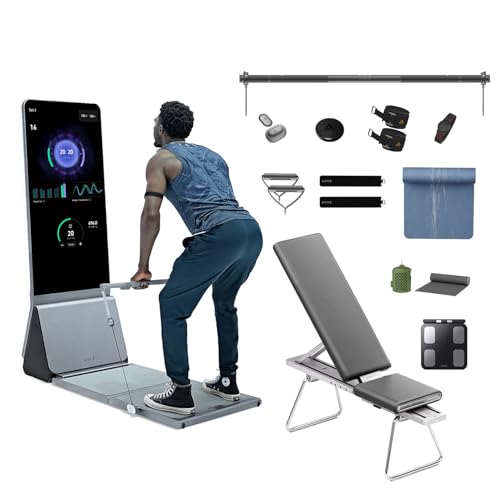
AEKE K1 Smart Home Gym System+Yoga Mat+Extender Belt+Workout Towel
For a traditional alternative built around fixed equipment, a power rack setup gives you heavier loading and more exercise variety. See Home Gym with Power Rack: 5 Best Picks Compared (2026) for options. Smaller-footprint choices are covered in Small Space Home Gym Equipment: 7 Picks and Layout Tips That Work.
FAQ
Is the AEKE K1 smart home gym good for beginners?
Yes, for many beginners it is a reasonable starting point. Guided sessions and on-screen cues reduce the guesswork of planning routines. Beginners should still start with lighter resistance, focus on controlled form, and build up gradually.
Can the AEKE K1 replace a full gym?
For general fitness, it can cover a lot of ground. It will not replace a barbell and rack for heavy compound lifts or a commercial machine selection. Think of it as a complement to, or a substitute for, basic home training rather than a full gym.
How much space do I need?
Plan for a clear area that allows you to step back, extend your arms, and move through full ranges of motion safely. Check the manufacturer’s stated dimensions and add extra room for the mount and your movement. The space-planning guides linked above give practical measurements.
Does it need a subscription?
Some connected fitness systems include coaching at purchase and offer premium content on a recurring basis. Check the listing and the app’s terms to see what is included and what might require ongoing payment.
Is it suitable for building muscle?
It can support muscle development in people who are new to training or who are progressing from very low activity, because even moderate resistance is a stimulus at that stage. Experienced lifters typically need heavier loads and more precise progression, which this type of system may not provide for long.
What maintenance does it need?
Inspect mounting hardware and any cables, bands, or resistance components regularly. Keep the area clean and dry, and follow the manufacturer’s care instructions. A quick check before each session catches most problems early.
Should I consult a professional before starting?
Yes. If you have a heart condition, joint problems, a recent injury, high blood pressure, or any other health concern, speak with a doctor or qualified fitness professional before starting a new program. Proper form and safe progression matter, especially with guided systems that may not catch every error.
How does it compare to a traditional home gym?
A connected mirror-style system trades heavy loading and exercise variety for guidance, compact size, and convenience. A traditional rack-and-plates setup offers more load and flexibility but needs more space, more setup, and more self-direction.
Final Verdict
The AEKE Smart Home Gym System, Fitness Mirror K1, is a sensible choice for people who want guided, all-in-one strength training in a small space. Its strengths are structure, convenience, and a low barrier to starting. Its limits are the resistance ceiling and the depth of guidance for advanced users. Match it to your goals, check the specifications and software terms on the listing, and compare it with the alternatives above before committing. You can view the current listing here: View on Amazon.
About Graham Fisher
Graham Fisher is part of our editorial team and reviews and edits our budget home gym equipment guides, checking product details against manufacturer specifications and owner feedback.