 By Graham Fisher
Updated November 2026
Choosing a home gym with power rack setup is less about finding the single best machine and more about matching a rack to your room, your lifts, and how much you want to add over time. A power rack gives you safe bar-supported squats, presses, and pulls, and most full-cage models add pulley systems, dip handles, and landmine attachments. This list compares five power cages on the criteria that matter most at home: footprint and ceiling clearance, load capacity, cable and pulley options, attachment variety, and the build quality owners tend to mention after months of use.
Our top picks at a glance
- 1
 TOP CHOICEBest overallDP01 Power Cage, 2000LBS Squat Rack with Cable Crossover and Dual IndeView on Amazon
- 2
 TOP CHOICEBest for multi-attachment trainingPower Cage, Multi-Functional Power Rack with J-Hooks, Dip Handles, LanView on Amazon
- 3
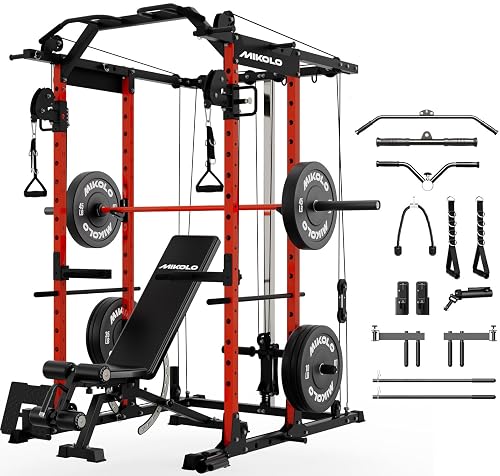 TOP CHOICEBest for lat work on a budgetMikolo Power Cage, Power Rack with Cable Crossover System, 1500LBS SquView on Amazon
- 4
 Best for all-in-one stationspooboo Power Cage Smith Machine with LAT Pulldown and Dual Pulley Cable CrossoverView on Amazon
- 5
 Best for a compact cage with pulleysSPORTSROYALS Power Rack, Multi-Functional Power Cage, Squat Rack withView on Amazon
Our Top Picks
Quick Comparison
| Product | Best for | Key feature |
|---|---|---|
| DP01 Power Cage, 2000LBS Squat Rack | Heavy strength training with full cable work | Dual independent pulley system and cable crossover |
| Power Cage, Multi-Functional Power Rack | Varied workouts with many attachments | J-Hooks, dip handles, and landmine attachment |
| Mikolo Power Cage, 1500LBS Squat Rack | Back and lat development | LAT pull-down system with cable crossover |
| pooboo Power Cage Smith Machine | Users who want one unit for many stations | Adjustable stations with Smith-style bar guide |
| SPORTSROYALS Power Rack | Smaller rooms that still need pulleys | Pulley system with LAT pull-down and J-hooks |
DP01 Power Cage, 2000LBS Squat Rack with Cable Crossover and Dual Independent Pulley System
DP01 Power Cage, 2000LBS Squat Rack with Cable Crossover and Dual Independent Pulley System, Full Cage for Full Body Training, Power Rack with More Training Attachments for Home Gym
Best for: heavy strength training with full cable work
This cage suits lifters who want a true full-body setup in one frame: squats and presses on the rack, plus cable crossover and pulley work for accessory movements. The dual independent pulleys let you train one side or both at once, which owners often mention as useful for unilateral work.
Key specs
- Listed capacity: 2000 lbs
- Dual independent pulley system with cable crossover
- Full cage design for safety catches and bar supports
Pros
- Dual independent pulleys allow asymmetric training
- Full cage frame supports heavy solo lifting
- Good range of training attachments for the price tier
Cons
- Full cage needs more floor space than a half rack
- Assembly takes a second person and a few hours
Bottom line: A strong pick for lifters who want heavy-duty capacity and cable work without buying separate machines.
Power Cage, Multi-Functional Power Rack with J-Hooks, Dip Handles, Landmine Attachment and Optional Cable Pulley System
Power Cage, Multi-Functional Power Rack with J-Hooks, Dip Handles, Landmine Attachment and Optional Cable Pulley System for Home Gym
Best for: varied workouts with many attachments
This is the most attachment-heavy option on the list. If you like switching between squats, dips, landmine rows, and cable work without buying extra stands, the included hooks and handles cover a wide range of movements.
Key specs
- J-Hooks and dip handles included
- Landmine attachment for rows and presses
- Optional cable pulley system
Pros
- Wide variety of attachments in one frame
- Landmine adds unilateral and rotational work
- Cable pulley is optional, so you can start lean
Cons
- Attachments add setup time between exercises
- Upgrading to cables later may need extra hardware checks
Bottom line: Best for lifters who value exercise variety and want to build out the cable side gradually.
Mikolo Power Cage, Power Rack with Cable Crossover System, 1500LBS Squat Rack with LAT Pull Down System
Mikolo Power Cage, Power Rack with Cable Crossover System, 1500LBS Squat Rack with LAT Pull Down System, Workout Cage with Pulley System for Fitness Home Gym
Best for: back and lat development
The LAT pull-down system is the reason to look at this model. It gives you a dedicated vertical pulling station alongside the squat rack, which is useful if pull-ups are still out of reach or you want controlled lat volume.
Key specs
- Listed capacity: 1500 lbs
- LAT pull-down system
- Cable crossover system
Pros
- Dedicated LAT pull-down station
- Cable crossover adds chest and shoulder variety
- Lower listed capacity than the 2000 lb models suits most home lifters
Cons
- Lower listed capacity may limit very heavy squatters
- Cable system wears over time and needs periodic checks
Bottom line: A good fit for people who want a pulldown station and a squat rack in one footprint.
pooboo Power Cage Smith Machine with LAT Pulldown and Dual Pulley Cable Crossover
LAT Pulldown and Dual Pulley Cable Crossover with All-in-One Home Gym Machine, Adjustable Stations and Training Attachments pooboo Power Cage Smith Machine with 2000LB Squat Rack Cable System
Best for: users who want one unit for many stations
This all-in-one design combines a Smith-style guided bar, adjustable stations, a LAT pull-down, and dual pulleys. It is a good match for people who want one large machine rather than assembling accessories over time.
Key specs
- Listed capacity: 2000 lbs
- Smith machine function with adjustable stations
- LAT pull-down and dual pulley cable crossover
Pros
- Guided bar option helps beginners learn lifts
- Multiple stations in one frame
- Dual pulleys support a wide range of cable exercises
Cons
- Smith-style guided bars limit stabilizer work compared with free-bar racks
- Large footprint requires careful room planning
Bottom line: Ideal for beginners or users who prefer guided movement and want many stations under one frame.
SPORTSROYALS Power Rack, Multi-Functional Power Cage with Pulley System, LAT Pull Down and J Hooks
SPORTSROYALS Power Rack, Multi-Functional Power Cage, Squat Rack with Pulley System & LAT Pull Down, Workout Cage with J Hooks for Home Gym
Best for: smaller rooms that still need pulleys
This cage packs a pulley system, LAT pull-down, and J-hooks into a frame that is generally easier to fit in a spare room or garage bay than the largest full cages. It suits lifters who want cable work without giving up most of the floor.
Key specs
- Pulley system with LAT pull-down
- J-hooks for squats and presses
- Multi-functional power cage design
Pros
- Pulley and LAT options in a relatively compact frame
- J-hooks cover the core barbell lifts
- Good starting point for a first power cage
Cons
- Less attachment variety than the multi-accessory models
- Cable components should be inspected regularly
Bottom line: A practical choice for small garages or spare rooms where space is tight but cable work still matters.
Buying Guide
Footprint and ceiling height
Measure before you order. Most power cages need at least 7 feet of ceiling height for pull-up bars and overhead work, and a footprint of roughly 4 by 6 feet for the frame plus 2 to 3 feet of clear space around each side for loading plates and moving safely. A full cage with pulleys often needs the most room. Read the manufacturer’s dimension list and tape out the footprint on the floor before buying. For room layout ideas, see Planning Home Gym Space: Clearances and Layout.
Good picks for this: SPORTSROYALS Power Rack, Mikolo Power Cage
Load capacity and frame construction
Check the listed weight capacity, but also look at the gauge of steel and the weld quality described by the manufacturer. A higher listed capacity is a useful signal of frame strength, especially for heavy squats. Confirm that the rack is anchored to the floor where the manufacturer recommends it, particularly for lifts above your bodyweight.
Good picks for this: DP01 Power Cage, pooboo Power Cage Smith Machine
Cable and pulley systems
Dual independent pulleys allow one-arm and asymmetric work. A single pulley is fine if you mainly want lat pulldowns and face pulls. Check the cable rating, the pulley bearing type, and whether the cable routing keeps the line clear of the bar path. Owners often report that cable and pulley wear is the first maintenance item, so plan periodic inspection.
Good picks for this: DP01 Power Cage, Mikolo Power Cage
Attachments and expandability
Think about the exercises you actually do. J-hooks and safety bars cover squats and bench presses. Dip handles, landmine attachments, and pull-up bars expand the list. If you plan to add a bench or plate storage later, make sure the frame has compatible hole spacing and mounting points.
Good picks for this: Power Cage Multi-Functional Power Rack, pooboo Power Cage Smith Machine
Use case: strength, hypertrophy, or general fitness
Heavy strength work favors a full cage with safety catches and a high capacity. Hypertrophy and general fitness benefit more from cable stations and attachments that let you vary angles and tension. Beginners may prefer a guided bar. Match the cage to the training you will do most often, not the most features on paper.
Good picks for this: pooboo Power Cage Smith Machine, Mikolo Power Cage
Durability and care
Powder-coated or painted steel resists wear, but bolts and pins loosen over time. Re-tighten hardware on a set schedule and inspect cable ends for fraying. For a fuller maintenance routine, see Preventive Maintenance for Home Gym Machines. Anchoring and storage also matter for safety; Home Gym Storage: Racks, Weights and Tip-Over Safety covers that in more detail.
Good picks for this: DP01 Power Cage, SPORTSROYALS Power Rack
Floor protection and noise
Dropped weights damage floors and transmit noise. Rubber tiles or rolled mats under the cage protect slab or subfloor and reduce vibration. If you train early or share a wall, consider the sound plan too. Rubber Mat Gym Flooring: 7 Best Picks for Home Gyms in 2026 and Reducing Home Gym Noise and Protecting Hearing are useful next reads.
Good picks for this: Power Cage Multi-Functional Power Rack, SPORTSROYALS Power Rack
FAQ
What is the difference between a power rack and a power cage?
A power rack usually refers to a squat rack with safety bars and J-hooks. A power cage generally adds a fuller frame, often with pulleys, cable crossover, and extra attachment points. The terms overlap, so compare the actual features listed.
How much space do I need for a home gym with power rack?
Most racks need about 4 by 6 feet of footprint plus clearance around the sides. Full cages with pulleys need more. Check the manufacturer dimensions and allow room to load plates and step in and out safely.
Do I need to bolt a power rack to the floor?
Many manufacturers recommend anchoring, especially for heavy lifting or on uneven floors. Follow the instructions in the product manual. If you are unsure about installation on a slab, a qualified installer or contractor can advise.
Are cable pulley systems worth it on a budget rack?
They are if you plan to do lat pulldowns, face pulls, and cable accessory work regularly. If your main goal is squats and bench presses, a basic rack with J-hooks may be enough, and you can add cables later.
How often should I inspect cables and hardware?
Check cables, pulleys, and bolts before each heavy session at a minimum, and perform a deeper inspection monthly. Replace frayed cables and re-tighten hardware according to the manufacturer’s guidance.
Can a power rack handle heavy squats safely?
Safety depends on the frame, anchoring, correct safety bar height, and your technique. Set the safety bars just below your lowest squat depth and use a spotter or the safety catches when training heavy. For injury-related questions, consult a qualified professional.
Is a Smith-style machine a good substitute for a free-bar rack?
A guided bar limits stabilizer work, which can make it easier for beginners to learn movement patterns. Many lifters eventually want free-bar training as well, so consider whether the guided bar matches your long-term goals.
Conclusion
For most home lifters, the right home gym with power rack depends on three things: the room you have, the cable work you want, and how heavy you plan to lift. The DP01 Power Cage suits heavy strength training with full cable access. The Power Cage Multi-Functional Power Rack suits lifters who want many attachments. The Mikolo Power Cage fits people focused on lat work. The pooboo Power Cage Smith Machine works for beginners and users who want many stations in one frame. The SPORTSROYALS Power Rack is a practical pick for smaller rooms that still need pulleys. Measure your space, confirm your capacity needs, and check the manufacturer’s specifications before you buy.
Sources
- Consumer product safety guidance for exercise equipment, including tip-over and assembly hazards (cpsc.gov)
- General workplace guidance on safe lifting and material handling that applies to heavy-weight training setups (osha.gov)
- Exercise guidelines from the American College of Sports Medicine on resistance training technique and progression (acsm.org)
About Graham Fisher
Graham Fisher is part of our editorial team and reviews and edits our budget home gym equipment guides, checking product details against manufacturer specifications and owner feedback.