As an Amazon Associate I earn from qualifying purchases. This page may contain affiliate links.
A leg extension machine for home gym setups isolates the quadriceps in a way that squats and lunges often can’t, and it does so without loading your spine or demanding the balance a free-weight movement requires. For anyone building a lower-body routine at home, it’s one of the most practical single-purpose machines to add. The challenge is that the category ranges from simple seated frames with a basic weight stack to plate-loaded combination units that also handle leg curls and hamstring work. This guide looks at five models using the criteria that matter most in a home space: footprint, weight capacity, adjustment range, how the resistance is delivered, and whether the frame stays stable under load. Everything here is based on manufacturer specifications, brand reputation and patterns owners commonly report, not on hands-on testing.
Our Top Picks
Quick Comparison
| Product | Best for | Key feature |
|---|---|---|
| J10 Leg Extension and Curl Machine | Compact spaces and simple seated training | Adjustable seated leg extension and lying curl in one frame |
| GMWD Leg Extension and Curl Machine | Plate-loaded progression on a budget | Plate-loaded resistance with rotary extension |
| Plate-Loaded Adjustable Leg Extension and Leg Curl Machine | Lifters who want heavier loading and transport | 400 lb rated capacity with transport wheels |
| Leg Extension and Curl Machine 4 in 1 | Multi-function lower-body training | Four training modes including bench use |
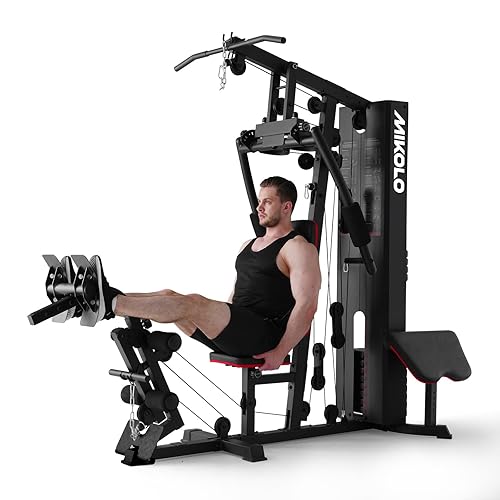
| Mikolo Leg Extension and Curl Machine | Users who want a smooth, lower-noise resistance feel | 1:1 resistance system with seated extension and lying curl |
J10 Leg Extension and Curl Machine

J10 Leg Extension and Curl Machine, Adjustable Leg Curl Machine for Home Gym, Seated Leg Extension and Lying Curl Machine for Lower Body Workouts
This model suits people with limited floor space who want a seated leg extension and a lying leg curl without buying two separate machines. It is a good fit for beginners and for anyone building a basic lower-body routine in a spare room or corner.
Key specs
- Seated leg extension and lying leg curl in one frame
- Adjustable seat and pad positions to fit different leg lengths
- Designed for home gym lower-body workouts
Pros
- Combines extension and curl functions in a single footprint
- Adjustable positioning helps fit a range of body sizes
- Suits short training sessions in limited space
Cons
- Lighter-duty build than plate-loaded options, which may limit heavy progression
- Owners who train at high loads may outgrow the resistance range
GMWD Leg Extension and Curl Machine

GMWD Leg Extension and Curl Machine, Lower Body Special Leg Machine, Adjustable Leg Exercise Bench with Plate Loaded, Leg Rotary Extension for Thigh, Home Gym Weight Machine
This is aimed at users who want to progress over time by adding weight plates rather than replacing the machine. It fits people comfortable with a plate-loaded setup who want a lower-body machine that can grow with their strength.
Key specs
- Plate-loaded resistance system
- Adjustable leg exercise bench
- Rotary extension design for thigh training
Pros
- Plate loading allows gradual, precise increases in resistance
- Covers both leg extension and leg curl movements
- Adjustable bench accommodates different body sizes
Cons
- Requires buying and storing weight plates separately
- Plate-loaded frames take more floor space than simple seated units
Plate-Loaded Adjustable Leg Extension and Leg Curl Machine

Plate-Loaded, 1" & 2" Plate Compatibility, Cable Connection, 17.3" Wide Seat, Transport Wheels, 400 LB Capacity Adjustable Leg Extension and Leg Curl Machine for Home Gym
This model is for lifters who want higher loading capacity and a machine they can move around. Its stated 400 lb capacity and transport wheels make it a sensible choice for garage gyms where equipment gets shifted for other uses.
Key specs
- 400 lb rated capacity
- Compatible with 1-inch and 2-inch plates
- 17.3-inch wide seat
- Transport wheels
- Cable connection
Pros
- High stated capacity supports heavier progression
- Transport wheels make repositioning easier
- Accepts both 1-inch and 2-inch plate sizes
Cons
- Requires a plate collection to use fully
- Larger overall footprint than seated-only models
Leg Extension and Curl Machine 4 in 1

Leg Extension and Curl Machine, 4 in 1 Lower Body Workout Machine, Adjustable Leg Curl Machine with Plate Loaded, Leg Extension Machine with Exercise Bench, Home Gym Weight Machine
This suits people who want more training variety from one unit, including a bench-based setup alongside extension and curl work. It is a reasonable pick for a home gym that needs to cover several lower-body movements without adding equipment.
Key specs
- Four-in-one lower-body configuration
- Plate-loaded resistance
- Adjustable leg curl and extension positions
- Includes an exercise bench
Pros
- Multiple training modes reduce the need for extra machines
- Plate loading supports gradual strength gains
- Bench inclusion adds versatility for other movements
Cons
- Multi-function frames can involve more setup time to change positions
- Combined design may compromise on the simplicity some users prefer
Mikolo Leg Extension and Curl Machine

Mikolo Leg Extension and Curl Machine, Adjustable Leg Curl Machine for Home Gym, Seated Leg Extension and Lying Leg Curl Machine, Leg Workout Equipment with 1:1 Resistance System
This model is suited to people who want a seated leg extension and lying leg curl with a resistance system designed for a consistent feel through the range of motion. It fits home users who prioritize smooth movement and a compact layout.
Key specs
- Seated leg extension and lying leg curl
- 1:1 resistance system
- Designed for home gym lower-body training
Pros
- Combines extension and curl in one unit
- Resistance system is intended to feel consistent through the movement
- Suits compact home training areas
Cons
- Maximum resistance may be lower than plate-loaded alternatives
- Specific capacity and adjustment details should be checked in the listing before purchase
Buying Guide
Choosing a leg extension machine for home gym use comes down to a few measurable factors. Start with the space you have, then the heaviest load you expect to use in the next year or two, and finally the other movements you want the machine to cover.
Selection criteria
- Footprint: Measure the floor area with the seat fully extended and the pad at full travel. Leave clearance behind and in front so you can enter and exit safely. For space planning, see Planning Home Gym Space: Clearances and Layout.
- Weight capacity: Check the manufacturer’s stated maximum user weight and the maximum resistance the machine can hold.
- Adjustability: Look for seat and pad adjustments that let your knees line up with the pivot point. Poor alignment causes discomfort regardless of load.
- Resistance type: Plate-loaded designs allow small, consistent increases. Fixed-stack or proprietary systems may offer less granular progression.
Important features
- A stable, welded or bolted frame that does not rock when loaded
- Padded seat and back support sized for your body
- Smooth pivot points and clean travel through the range of motion
- Safety stops or limit points that prevent the pad from overtraveling
- Pins or clips that lock the weight securely
Specs to check
| Spec | What to look for |
|---|---|
| Max user weight | Should exceed your body weight with margin |
| Max resistance | Should cover your planned progression |
| Plate compatibility | Confirm 1-inch, 2-inch, or both if plate-loaded |
| Seat and pad adjustment | Range that fits your leg length |
| Footprint | Matches your floor space with clearances |
Choosing by need
- Small room, basic training: A compact seated extension and curl unit is usually enough.
- Long-term strength progression: A plate-loaded model with a higher stated capacity gives more room to grow.
- Multiple lower-body movements: A multi-function frame reduces the number of machines you need.
- Garage gym with moving equipment: Transport wheels help when you need to reposition the machine.
Things to watch out for
- Do not exceed the stated weight or resistance limits.
- Check that all pins and clips engage fully before each set.
- Verify the frame sits level on your floor. Uneven flooring can cause wobble under load. The basics are covered in Home Gym Flooring Basics: Level, Protected and Stable.
- Keep children away from the machine during use. More on this in Home Gym Equipment Safety: Kids, Keys and Catches.
- Inspect bolts and pivot points periodically. Preventive Maintenance for Home Gym Machines outlines a simple inspection routine.
FAQ
Is a leg extension machine necessary for building leg strength?
No. Squats, lunges and deadlifts build leg strength effectively. A leg extension machine adds targeted isolation for the quadriceps and can help with specific training goals, but it is a supplement rather than a requirement.
Can I use a leg extension machine if I have knee problems?
Seated leg extensions load the knee in a specific way, and some people with knee conditions find them uncomfortable. Consult a physical therapist or physician before starting, especially if you have a current injury or pain.
What is the difference between a seated and a lying leg curl?
Seated machines work the hamstrings with the knee bending from a seated position. Lying curls use a prone position and target the hamstrings with the hips flat. Both are common, and some combination machines offer each.
How much space should I leave around a leg extension machine?
Leave enough room to sit down, adjust the pad, and stand up without hitting walls or other equipment. Measure the machine’s full footprint and add clearance on all sides. The planning guide How Much Space Do You Need for a Home Gym? gives general room sizes.
Do I need a bench or rack alongside the machine?
Not necessarily. A leg extension machine works on its own. A bench or rack expands the training options for other exercises, which is why many home gyms build around a multi-function layout.
How often should I inspect the machine?
Check pins, bolts, pivot points and pads before each session, and perform a more thorough inspection every few weeks depending on use. Consult the manufacturer’s maintenance recommendations for your specific model.
Can a leg extension machine fit in a small apartment?
Compact seated models often do. Measure carefully and confirm the footprint and weight before buying, since some heavier machines need reinforced flooring or more room than expected.
Conclusion
For a compact space and straightforward seated work, the J10 and Mikolo models are worth comparing. If you plan to progress with added weight, the GMWD and plate-loaded models give more room to grow, and the plate-loaded unit with transport wheels suits a garage gym that gets rearranged. The 4-in-1 frame fits anyone who wants several lower-body movements from one machine. Before buying any leg extension machine for home gym use, confirm the stated capacity, footprint and adjustment range against your own body measurements and training goals. Specifications come from the manufacturer and can change between versions, so verify them on the listing.