 By Ethan Brooks
Updated November 2026
A power rack leg press attachment bolts onto the lever arms of a compatible rack and gives you a footplate for pressing weight with your legs, without loading a barbell across your back. This review looks at the Titan Fitness Leg Press Power Rack Attachment, which is built for the company’s T-3 and X-3 series racks. It suits lifters who already own one of those racks and want a low-cost way to add lower-body pressing. It is a poor fit for anyone with a different rack brand, a short ceiling, or a plan to replace free squats and deadlifts with machine work.

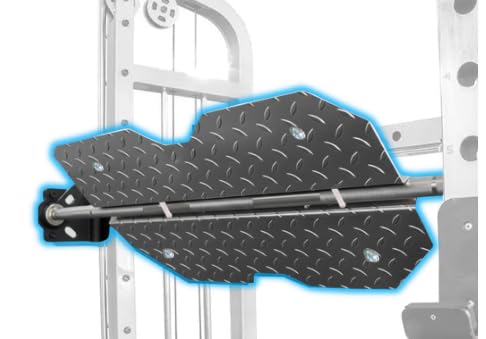
Titan Fitness Leg Press Power Rack Attachment Fits T-3 and X-3 Series Power Racks, Slip-Resistant Diamond-Plated Footplate, Connects to Lever Arms with Quick Pins, Lower Body Rack Attachment
Product Overview
The Titan attachment is a steel footplate assembly designed to connect to the lever arms of Titan’s T-3 and X-3 power racks. Instead of a freestanding machine, it turns the rack you already have into a sled-style leg press. You load plates onto the lever arms, sit or lie under the rack in the position the attachment dictates, and press the footplate away from your body. The listing describes a diamond-plated footplate for grip and a connection point that uses quick pins, which means setup does not require tools beyond the pins themselves.
The main appeal is footprint. A dedicated leg press machine can take up a large part of a garage gym. Because this attachment shares space with a rack you already own, it adds lower-body pressing capability without a second large piece of equipment. The tradeoff is that you are limited to the geometry and load path of the rack, so it will not match a commercial leg press in range of motion or comfort.
Key Features & Specifications
The table below lists only the details stated in the product name or widely associated with this model. Confirm dimensions and maximum load on the manufacturer’s listing before buying, since specifications can change between production runs.
| Feature | Details |
|---|---|
| Compatibility | Titan T-3 and X-3 series power racks |
| Footplate | Slip-resistant, diamond-plated steel |
| Connection method | Attaches to rack lever arms with quick pins |
| Function | Lower body rack attachment for leg pressing |
| Setup tools | Quick pins; no specialized tools listed |
| Rack requirement | Requires a compatible T-3 or X-3 rack with lever arms |
Pros & Cons
Pros
- Uses equipment you may already own, so no separate machine footprint.
- Diamond-plated footplate is designed to reduce slipping under load.
- Quick-pin connection avoids a long assembly process.
- Gives a safer alternative to heavy leg pressing from the floor when a rack is already set up.
- Budget-friendly option compared with a standalone leg press machine.
Cons
- Only fits Titan T-3 and X-3 racks; it is not a universal accessory.
- The movement path follows the rack, which may not suit every body type or squat-style preference.
- Maximum load and exact range of motion depend on the rack configuration.
- Requires clear floor and ceiling space around the rack to load plates and move freely.
- Not a substitute for a full commercial leg press in comfort or seat support.
Performance Analysis
Based on the listing details and common owner feedback patterns for rack-mounted leg press attachments, performance comes down to three things: footplate grip, connection stability, and the training position it creates. Owners of similar attachments often report that the footplate stays put when the surface is clean and the feet are placed flat, which matters more than any spec on paper. Stability depends on the quick pins being fully seated and the lever arms set at the correct height. Loose pins are the most commonly reported source of concern, so checking them before every session is a sensible habit.
Training range is the second consideration. A rack-based press generally has a shorter, more fixed arc than a seated machine. For lifters chasing quad development through deep knee flexion, the limited range may feel restrictive. For those who want to press heavy without stressing the lower back, the controlled path can be a useful complement to squats. Manufacturers typically recommend starting with light loads to learn the movement, and that advice applies here. Consult a qualified trainer or your physician if you have knee, hip, or back concerns before adding any new lower-body exercise.
Who Should Buy This Product?
This attachment makes the most sense for home gym owners who already have a Titan T-3 or X-3 rack and want more leg training variety without buying a separate machine. It also works for lifters who want a supported pressing option during periods when free squatting feels hard on the back or when they are rebuilding after a layoff.
Skip it if your rack is from another brand, if you own a half rack without lever arms, or if you plan to rely on leg pressing as your only lower-body exercise. Lifters who want the full range of a 45-degree leg press should look at a dedicated machine instead.
Buying Guide
Before buying any power rack leg press attachment, measure your rack and confirm compatibility. Check the model series printed on the upright or in the manufacturer documentation. A mismatch will not connect properly, and returns can be a hassle.
Next, check your space. You need room to load plates, step onto the footplate, and clear the area when you finish. A minimum clearance of about 3 feet around the front and sides of the rack is a practical target, and more is better if you plan to load heavy plates.
Look at the footplate surface and the pin system. A diamond-plated or textured footplate reduces slipping, and quick pins that lock positively make setup faster and safer. Read owner reviews for comments about pin wear or loose fit, since those issues show up quickly in practice.
Consider your training goals. If you want maximum quad range or a padded seat, a standalone leg press may serve you better. If you want a space-saving, rack-integrated option, an attachment like this is the more logical route. Many home gym builders also compare this against other rack accessories. For example, Power Rack vs Power Cage (2026): Which Is Better for Your Home Gym? explains how rack style affects what accessories fit your setup.
If you want an alternative that works with a different rack style, the Leg Press Attachment for Smith Machine is worth comparing:
Leg Press Attachment for Smith Machine
For a rack-mounted option that handles leg extensions, curls, and pulldowns through a 1-inch hole pattern, the JEEKEE Rack Mounted Leg Extension and Curl Attachment is another well-known choice:

JEEKEE Rack Mounted Leg Extension & Curl Attachment, 280LB Capacity, Adjustable Power Rack Accessory for Leg Training, LAT Pulldown & Row, Fits 1-Inch Holes, 2×2, 2×3 & 3×3 Racks
Both give you different training options than a pressing footplate. If you are still choosing a rack, 6 Best Power Racks with Attachments for Home Gyms: 6 Compared (2026) and Home Gym with Power Rack: 5 Best Picks Compared (2026) can help you match a rack to the accessories you want.
FAQ
Does this attachment fit every power rack?
No. The listing names Titan T-3 and X-3 series racks. Check your rack’s model series before ordering. Racks from other manufacturers generally use different lever arm dimensions and will not connect properly.
Do I need a spotter or safety bars?
Safety bars are strongly recommended whenever you load a rack-based press. Set the bars slightly below the lowest point of your intended range so the load can be caught if you fail a rep. Consult your rack’s manual for correct safety bar height.
Can I use this for heavy leg pressing?
Maximum load depends on the rack and attachment combination. Check the manufacturer’s stated capacity and never exceed it. Start with light weight and progress gradually.
How much space do I need?
Plan for at least 3 feet of clearance in front and to each side of the rack, plus enough ceiling height to stand clear of the bar path. Measure your room before you buy.
Is this a good replacement for squats?
It is better thought of as a supplement. Free squats train balance, core stability, and full-body coordination that a rack-based press does not. Many lifters use leg pressing as an accessory movement alongside squats.
How do I know the quick pins are secure?
Seat each pin fully and confirm it has locked before loading. Give the footplate a firm test push with no weight on it before your first set. Recheck pins periodically, since repeated use can loosen them.
Will it damage my rack?
Attachments designed for a specific rack are built to distribute load through the lever arms. Avoid overloading beyond stated limits, and inspect welds and hardware regularly for wear.
Is professional advice needed before using it?
If you have a knee, hip, or back condition, consult a physician or physical therapist before adding leg pressing to your routine. A certified trainer can also help you set the correct foot position and range.
Final Verdict
The Titan Fitness Leg Press Power Rack Attachment is a practical choice for Titan T-3 and X-3 owners who want a rack-integrated way to press with their legs. It saves floor space, uses quick-pin setup, and provides a textured footplate. Its limits are real: compatibility is narrow, the range of motion follows the rack, and it does not replace free squats or a full commercial leg press. If your rack matches, it is worth considering as a supplemental lower-body tool.
Related reading
- 6 Best Power Racks with Pulley Attachment Options for Home Gyms (2026)
- 5 Best Cable Attachments for Power Rack Setups (2026)
- Wall Mounted Power Rack Compared: 6 Best Picks for Small Spaces (2026)
About Ethan Brooks
Ethan Brooks is part of our editorial team and reviews and edits our budget home gym equipment guides, checking product details against manufacturer specifications and owner feedback.