 By Ethan Brooks
Updated November 2026
A power strip server rack unit is a 1U rackmount PDU, short for power distribution unit, that mounts in the same 19-inch rails as your network gear, servers, or audio equipment. If you run a small network closet, a home lab, or a rack-mounted media setup, it keeps cords tidy and gives you outlets where the hardware actually sits. This review covers the StarTech 8-outlet 1U PDU, a rackmount surge-protected strip with a rugged steel chassis. It suits people who want a clean, professionally styled rack power solution and who plan to use it with standard 120V equipment. It is a poor fit for anyone who needs remote switching per outlet, metering, or high-amperage circuits, and for whom a basic power strip on a shelf would be enough. Read on for the specifications, the trade-offs, and what to check before you buy.
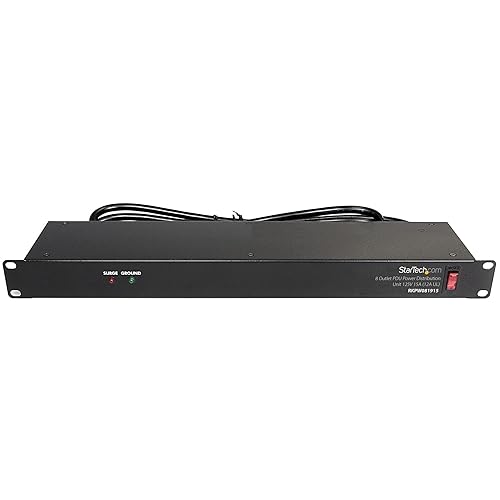
Power strip for network server racks, Surge protection, Rugged steel chassis, LED ground and surge indicators StarTech 8-Outlet 1U PDU, 120V/15A, Surge, 6ft Cord, TAA (RKPW081915)
Product Overview
The StarTech RKPW081915 is listed as an 8-outlet, 1U power distribution unit designed for network server racks. Its name describes a 120V, 15-amp model with surge protection, a six-foot power cord, and a TAA-compliant designation. The chassis is steel, and the front panel carries LED indicators for ground and surge status. Those indicators are the main visual cue that the unit is protecting your equipment and that the outlet wiring is correct.
The product sits in a clear niche. It is not a home-theater strip or a desktop surge protector with a bulky plastic housing. It is meant to be bolted into a 19-inch rack, usually between a patch panel and a switch, or near the bottom of a cabinet where cords can drop straight down. Most buyers in this category are either IT staff setting up a small wiring closet, or hobbyists building a home lab who want their gear to look and behave like a real data-center setup.
Key Features & Specifications
The table below lists only the specifications named in the product listing or those that are standard for this model family. Check the manufacturer’s data sheet before purchase if you need exact dimensions or load ratings.
| Feature | Specification |
|---|---|
| Form factor | 1U rackmount, fits standard 19-inch rack |
| Outlets | 8 outlets |
| Voltage and current | 120V, 15A |
| Surge protection | Included |
| Indicators | LED ground and surge indicators |
| Chassis | Rugged steel |
| Power cord length | 6 feet |
| Compliance | TAA compliant (per listing designation) |
| Model number | RKPW081915 |
Because the unit is 1U, it takes one rack unit of vertical space, which is roughly 1.75 inches of height. Plan your rack layout so you leave that space open and have enough cord reach to the nearest wall outlet.
Pros & Cons
Pros
- Built to mount in a standard 19-inch rack, so it looks and installs like other rack gear.
- Steel chassis is the expected material for rack hardware and holds up to rack mounting and cable tugging.
- Surge protection and LED indicators give you a quick visual check on power health.
- Eight outlets is enough for a typical small rack of switches, a router, a NAS, and a few servers.
- Six-foot cord gives reasonable reach from a rack to a wall outlet in most setups.
Cons
- Outlets are not individually switchable or remotely managed, so you cannot power-cycle a single device from software.
- No per-outlet metering, so you cannot see how much each device draws.
- The 15-amp rating limits total load. Heavy servers with high-draw power supplies can approach that ceiling quickly.
- Six feet of cord can be short if your rack sits far from the outlet, and longer cords are not always available from the same product line.
- Owners often report that the LED indicators are small and easy to miss from across a room.
Performance Analysis
Performance for a PDU like this comes down to three things: how well it distributes power without overloading, how reliably the surge protection and indicators work, and how easily it installs. Based on the specifications, the 15-amp, 120V rating gives you about 1,800 watts of total capacity at standard US voltage. In practice you should load the unit to no more than about 80 percent of that, roughly 1,440 watts, to leave headroom for inrush current when equipment powers on. A rack with several 1U servers, a switch, and a storage box can reach that limit faster than people expect, so add up the nameplate ratings of every device before you commit.
Owner feedback patterns for rackmount PDUs in general tend to focus on installation ease, cord routing, and whether the surge indicators stay accurate over time. Owners often report that the steel housing and standard rack ears make mounting straightforward, provided the rack rails are compatible. Surge protection is typically rated in joules, and that figure is worth checking against the listing or data sheet, since it defines how much transient energy the unit can absorb before the protection is used up. Because surge components wear with each event, plan to replace the unit after a major surge or if the indicator stops showing normal status.
What this unit does not do is manage power intelligently. It has no network interface, no switched outlets, and no load reporting. That is fine for a passive rack, but if you need to reboot a frozen server remotely, you would need a managed PDU, which is a different product class.
Who Should Buy This Product?
This unit fits you if you run a small server rack, a network closet, or a home lab and want a proper rackmount power strip with surge protection. It is also a good choice if your gear is all standard 120V and your total draw stays comfortably under 15 amps. People building a tidy rack for audio or AV equipment will also find the form factor useful.
Skip it if you need remote power control, outlet-level monitoring, or support for high-amperage 208V or 240V loads. Skip it if you want a plain power strip for a desk or entertainment center, where a cheaper, non-rackmount strip will do the job. Also skip it if your rack is far from an outlet and you cannot run a longer cord cleanly.
Buying Guide
Start by totaling the power draw of everything you plan to plug in. Look for the wattage or amperage on each device’s label or power supply, not just the outlet count. If the sum comes close to 1,440 watts on a 120V circuit, consider a higher-capacity unit or split the load across two PDUs on separate circuits.
Next, check the form factor. Confirm your rack is a 19-inch EIA design and that you have a free 1U space. Decide where the PDU will sit: near the top keeps cords short to patch panels, while near the bottom keeps the heaviest cords out of the way. Measure the cord reach from that spot to the wall outlet before you buy.
Then decide what kind of power management you need. A basic passive unit like this one is enough for most home racks. If you want remote reboot or per-outlet reporting, step up to a managed PDU. Here are two well-known alternatives in the rackmount category:
-
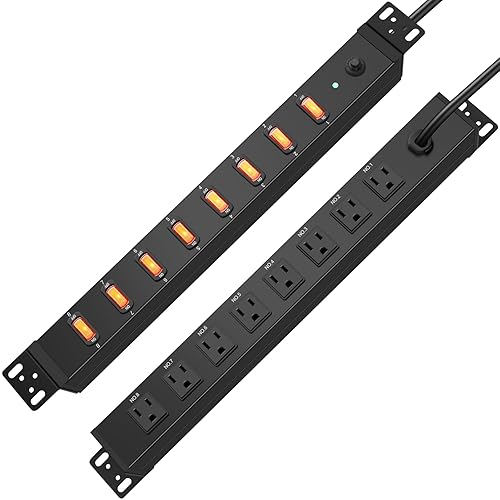
Metal Mountable Outlet with Independent Switch, for Network Server Audio Equipment Racks, 1200J 8 Outlet PDU Power Strip, 1U Rack Surge Protection, 6FT, Black, 1
– A metal-mountable 1U PDU with an independent switch and surge protection, aimed at audio and network equipment racks. View on Amazon
-

100-125V/15A, 10 Outlets, 15ft Power Cord, 1U Rackmount CyberPower CPS1215RM Basic PDU
– A CyberPower 1U rackmount PDU with 10 outlets and a 15-foot cord, useful when you need more outlets or longer reach. View on Amazon
If you are also planning the rest of your rack layout, the guide Home Gym Storage: Racks, Weights and Tip-Over Safety covers general rack stability, and Rack for Adjustable Dumbbells: How to Choose and Set One Up (2026) explains how to plan space and anchoring for heavy racks. For a broader look at rack hardware choices, see Best Squat Rack: 6 Home Gym Options Compared.
FAQ
Can I use this power strip server rack unit on a 240V circuit?
No. The listing describes a 120V, 15-amp unit. Running it on a 240V circuit would damage the equipment and create a serious fire and shock hazard. If you need 240V, look for a unit specifically rated for that voltage.
How much equipment can I plug into an 8-outlet 15-amp PDU?
Add up the maximum current draw of every device, not just the outlet count. Keep the total under about 80 percent of 15 amps, which is roughly 12 amps or about 1,440 watts at 120V. Check each device label, since power supplies can draw more during startup.
Does a passive PDU protect against all power problems?
Surge protection helps with voltage spikes, but it does not provide battery backup or full power conditioning. For uninterrupted operation during outages, pair the PDU with a UPS sized for your total load.
Can I mount this unit in a non-rack shelf?
It is designed for 19-inch rack rails. You can place it on a shelf, but the rack-mount ears and the intended cord routing are built for a rack, so a shelf setup may not be as tidy or secure.
Will the LED indicators tell me if the surge protection is used up?
The indicators show the current status of ground and surge protection. Owners often report that they are a useful quick check, but you should still replace a unit after a major surge event and confirm its condition against the manufacturer’s guidance.
What is the difference between a PDU and a regular power strip?
A PDU is built for rack mounting, usually with a steel chassis and standard rack ears, and is designed for continuous use in a server environment. A regular power strip is designed for desktop or wall use and is not built for rack mounting.
Should I buy a managed PDU instead?
Buy a managed PDU if you need to remotely power-cycle devices, monitor load per outlet, or track power use over time. If you only need a clean, surge-protected power source in a rack, a passive unit like this one is simpler and usually adequate.
Final Verdict
The StarTech 8-outlet 1U PDU is a sound, straightforward choice for a small server rack or home lab that runs standard 120V equipment under its 15-amp limit. Its strengths are the rugged steel build, the rack-standard form factor, the surge protection, and the simple LED status indicators. Its limits are real: no remote switching, no metering, and a 15-amp ceiling that heavier racks can exceed. If your needs are basic and your load is modest, it is a practical pick. If you need intelligence or more capacity, look at a managed PDU or a higher-rated unit instead.
Related reading
- Wall Mounted Power Rack Compared: 6 Best Picks for Small Spaces (2026)
- T 2 Series Power Rack Review: Features and Performance
About Ethan Brooks
Ethan Brooks is part of our editorial team and reviews and edits our budget home gym equipment guides, checking product details against manufacturer specifications and owner feedback.