 By Graham Fisher
Updated November 2026
Choosing the right flooring material for gym use at home comes down to four things: how much noise and impact it absorbs, how well it protects your subfloor under heavy weights, how easy it is to install and reconfigure, and whether it stays stable under equipment. The five options below are picked from product listings, brand reputation and common owner feedback patterns. We did not test them ourselves.
Best overall: Interlocking Gym Flooring for Home Gym, Heavy Duty Gym Mat – View on Amazon
Best for heavy lifting: AIRHOP 0.56in Thick Exercise Equipment Mats – View on Amazon
Best for dropped weights: Performance Series Interlocking Floor Tiles – View on Amazon
Best for a large room: VEVOR Rubber Top Interlocking Gym Flooring – View on Amazon
Best for a small budget footprint: SUPERJARE 0.56” Thick Rubber Top Gym Flooring – View on Amazon
Our Top Picks
| Product | Best for | Key feature |
|---|---|---|
| Interlocking Gym Flooring for Home Gym (B0DK8XSDC1) | Overall use | 0.56in rubber top, EVA base |
| AIRHOP Exercise Equipment Mats (B0CNG8MDWB) | Heavy lifting | High density EVA foam core |
| Performance Series Interlocking Floor Tiles (B0GVGNFBBG) | Dropped weights | ½in TPE rubber, no odor |
| VEVOR Rubber Top Gym Flooring (B0BR6RJQ7G) | Large rooms | 100 sq ft coverage |
| SUPERJARE Rubber Top Gym Flooring (B09NHQQGKR) | Small footprint | 12 interlocking pieces |
Interlocking Gym Flooring for Home Gym, Heavy Duty Gym Mat

Interlocking Gym Flooring for Home Gym, Heavy Duty Gym Mat, Non-Slip High Density EVA Foam, 24x24in Tiles, Protect Floors 0.56" Thick Rubber Top Exercise Equipment Mats, 12 Tiles 48 Sq Ft
Best for: Overall home gym use with mixed cardio and strength equipment.
A solid all-round choice for garage or basement gyms where the floor needs general protection without a specialized setup.
Pros
- Rubber top resists scuffs and gives a grippy surface.
- Tiles snap together without adhesive.
Cons
- Edges can lift if not pressed firmly during installation.
AIRHOP 0.56in Thick Exercise Equipment Mats

AIRHOP 0.56in Thick 48 Sq Ft Exercise Equipment Mats, 12 Tiles Upgraded Rubber Top with High Density EVA Foam, Large Interlocking Puzzle Gym Flooring for Home Gym, Heavy Weight Workout, 24 x 24in
Best for: Heavy lifting and high-impact training.
Suits lifters who load bars heavily and want a thicker cushion to protect the subfloor from repeated impact.
Pros
- Dense EVA core absorbs landing impact well.
- Large 24 x 24in tiles cover space quickly.
Cons
- Foam can compress under very heavy racks over time.
Performance Series Interlocking Floor Tiles

Performance Series Interlocking Floor Tiles – Durable ½ in TPE (Rubber Like, NOT Foam, no Odor) – Gym Flooring for Weights & Heavy Equipment – Black, 30 SqFt (12 Pack) – Made in USA
Best for: Dropped weights and heavy equipment.
A fit for lifters who drop plates regularly and want a rubber-like surface rather than foam.
Pros
- TPE material is described by the maker as odor-free and durable.
- Thinner profile suits low-ceiling spaces.
Cons
- Thinner than foam options, so less cushioning for jumping.
Rubber Top with Dense EVA Foam, Interlocking Gym Flooring
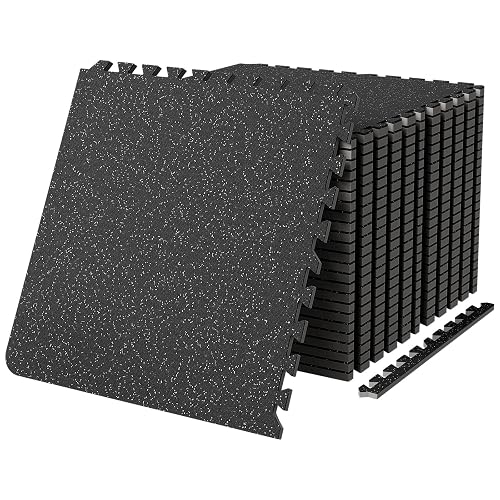
Rubber Top with Dense EVA Foam, Interlocking Gym Flooring for Home Gym, 25 x 25In, Durable, Cushioned, Waterproof, Anti-Slip VEVOR 0.56 inch 100 sq.ft Exercise Equipment Mats 25 Tiles Black & Gray
Best for: Covering a large room in one purchase.
Works well for a full training room where you want continuous coverage with fewer orders.
Pros
- 100 sq ft coverage across 25 tiles.
- Waterproof, anti-slip surface.
Cons
- Large quantity means more time spent on installation.
High Density Gym Mat with Upgraded Rubber Top

High Density Gym mat with Upgraded Rubber Top, 12 Pcs Interlocking EVA Foam Exercise Equipment mat, Workout Mat, Black/Grey SUPERJARE 0.56'' Thick 48 Sq Ft Rubber Top Gym Flooring for Home Gym
Best for: A smaller footprint or a corner workout zone.
Good for apartments or a single training corner where 48 square feet is enough.
Pros
- Covers a compact area without excess tiles.
- Rubber top is easy to wipe clean.
Cons
- Limited coverage for larger equipment setups.
Buying Guide
Thickness and Impact Absorption
Most interlocking mats in this range are about 0.5 inches thick, and that is enough for light to moderate lifting. Thicker foam helps with jumping and dropped weights, but very thick mats can wobble under racks. For more on thickness, see How Thick Should Gym Flooring Be? A Practical Guide for Home Gyms.
Good picks for this: AIRHOP 0.56in Thick Exercise Equipment Mats, Interlocking Gym Flooring for Home Gym
Surface Material: Rubber Top vs. Foam vs. TPE
Rubber tops resist scuffs and offer grip, while TPE is often described as more rubber-like with less odor. Foam-only surfaces are softer but can tear under heavy loads. Compare options in Rubber vs Interlocking Tile: Gym Weight Room Flooring Compared (2026).
Good picks for this: Performance Series Interlocking Floor Tiles, High Density Gym Mat with Upgraded Rubber Top
Coverage and Layout
Measure your room first and add a margin for overlap at the edges. Many 24 x 24in tiles cover 4 square feet each, so a 12-tile pack gives 48 square feet. For planning help, see Home Gym Flooring Basics: Level, Protected and Stable.
Good picks for this: VEVOR Rubber Top Interlocking Gym Flooring, SUPERJARE Rubber Top Gym Flooring
FAQ
What is the best flooring material for a home gym?
The best choice depends on your workouts. Rubber top tiles with dense EVA foam underneath work well for general training, while thicker rubber-style TPE tiles suit heavy weights and dropped equipment. Consider noise, subfloor protection, and how easily you can install and reconfigure the floor.
How thick should gym flooring be?
For most home gyms, a thickness of around half an inch to just over half an inch offers a good balance of impact absorption and stability. Thicker mats can absorb more shock from dropped weights but may be less stable under heavy machines. Check that the thickness suits the equipment you plan to use.
Do interlocking gym tiles stay in place during workouts?
Interlocking tiles are designed to lock together at the edges, which helps them stay aligned during training. Many have anti-slip surfaces as well. For heavy equipment, you may want to check the manufacturer’s guidance on securing the floor and leveling the subfloor first.
Can gym flooring go over concrete or wood?
Most interlocking gym tiles can be installed over concrete, wood, or other hard, level subfloors. Make sure the surface is clean and flat before installation. If you have a wood subfloor, check for moisture issues, since trapped moisture can affect both the floor and the structure below.
Is rubber or foam better for gym flooring?
Rubber top surfaces tend to offer better grip and durability under weights, while EVA foam provides cushioning and lower cost. Many products combine the two, with a rubber surface over a foam core. Your choice depends on whether you prioritize shock absorption, traction, or budget.
How do I clean and maintain gym flooring?
Regular sweeping or vacuuming removes dust and debris that can wear the surface over time. For spills and sweat, a mild cleaner and a damp cloth usually work well. Avoid harsh solvents, which can degrade some foam and rubber materials, and follow the manufacturer’s care instructions.
Conclusion
If you do general strength training, cardio, and bodyweight work, an interlocking rubber-top tile over EVA foam is a practical, flexible choice. It offers good cushioning and grip without a complicated installation.
If you lift heavy or drop weights often, look at the thicker or TPE-based options that focus on impact absorption and subfloor protection. Match the flooring to your heaviest equipment and the surface beneath it, and you will get the most value from your home gym setup.
Related reading
- Wood Flooring for Gym: 7 Best Picks for Home Gyms in 2026
- What Is Woven Vinyl Gym Flooring and Is It Right for a Home Gym?
- Top 7 Rubber Gym Flooring Roll Options for Home Gyms in 2026
- Top 7 Cork Floorings for Gym Options for Home Gyms in 2026
About Graham Fisher
Graham Fisher is part of our editorial team and reviews and edits our budget home gym equipment guides, checking product details against manufacturer specifications and owner feedback.


